The Querilla Journal
Did Africa Have History? Why Hugh Trevor-Roper Was Wrong
Explore how oral traditions and archaeological evidence challenge Hugh Trevor-Roper’s claim that Africa had no history.
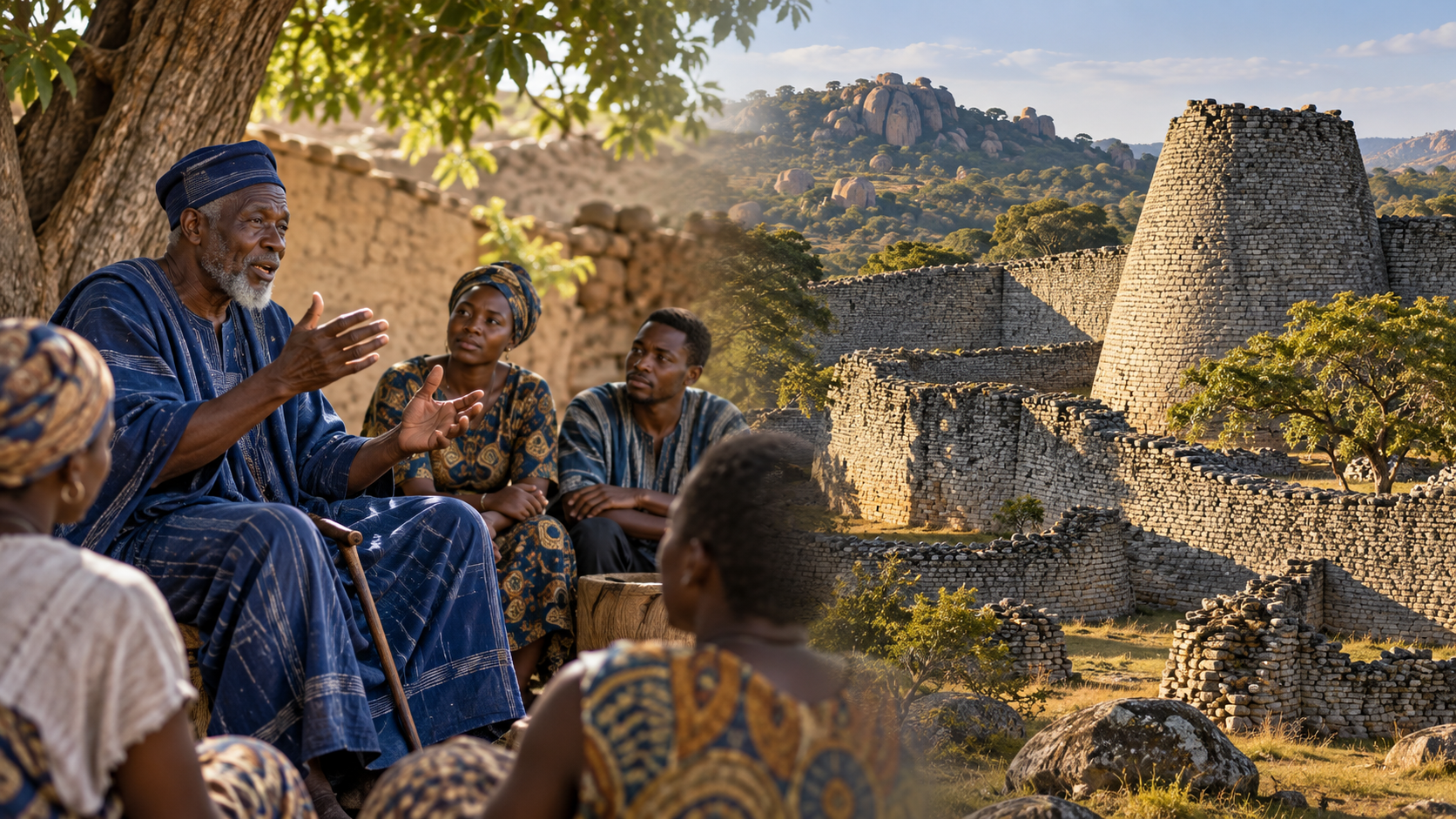
Using oral traditions and archaeology to challenge the claim that Africa had no history
Did African history begin with the arrival of Europeans? The question exposes a longstanding problem in historical scholarship: whose experiences count as history, and which evidence deserves recognition?
In remarks made in 1963, British historian Hugh Trevor-Roper dismissed much of Africa’s past as outside meaningful historical study, giving priority to the history of Europeans on the continent. His position is often summarised as the claim that Africa had no history. This reflected a narrow understanding of both historical significance and the evidence through which the past can be reconstructed.
Two sources demonstrate why this argument is misleading: oral traditions and archaeology. They reveal African political organisation, economic activity, cultural knowledge and social change long before European colonial rule.
1. Oral traditions: preserving knowledge across generations
Oral traditions are accounts and forms of knowledge transmitted from one generation to another through speech and performance. They include genealogies, narratives of origin, praise poetry, songs and accounts of migration.
They differ from oral history interviews focused on a narrator’s personal experiences. An oral tradition may concern events that occurred many generations before its present narrator was born.
UNESCO recognises that oral traditions transmit knowledge, social values and collective memory. Their preservation depends on people, performance and the circumstances in which they are communicated. The absence of a written manuscript therefore does not mean the absence of historical knowledge.
Example: Sunjata and the Mali Empire
The Sunjata traditions of West Africa illustrate this historical value. Preserved and performed by specialist narrators commonly called griots, or jeliw in Mande contexts, these traditions recount Sunjata’s life and the emergence of the Mali Empire in the thirteenth century.
They contain accounts of political struggles, alliances, leadership and relationships between communities. UNESCO’s account of the Sosso-Bala cultural tradition identifies the continuing transmission of epic poems associated with Sunjata and the foundation of Mali.
Such traditions provide material for investigating how political authority was established and remembered. They also reveal the values through which later generations understood leadership, obligation and belonging.
Their significance directly challenges Trevor-Roper’s argument. African communities preserved interpretations of their own past, rather than waiting for Europeans to give them a history.
How historians evaluate oral traditions
Oral traditions must nevertheless be examined critically. A narrator may praise a ruling family, omit a defeat or incorporate episodes from different periods. Performance can change according to the audience and purpose.
Research on the Sunjata epic specifically highlights the difficulty of separating material associated with the founding period from elements introduced through later historical experience.
Historians therefore compare versions, investigate who transmitted them and consider whose interests they serve. They distinguish evidence about an earlier event from evidence about how that event was remembered.
These limitations require careful interpretation. They do not justify dismissing oral traditions altogether. Written records also contain omissions, exaggerations and political bias.
2. Archaeology: reconstructing the past through material remains
Archaeology investigates past societies through material evidence. Buildings, pottery, tools, food remains, burial sites and production debris can help historians reconstruct settlement, technology, livelihoods and exchange.
The location and context of an object matter as much as the object itself. A pot recovered from a documented excavation provides different information from one removed without a record of where it was found. Dating methods and relationships between layers help establish sequences of occupation and change.
Archaeology is particularly valuable where written records are limited. It allows researchers to investigate people whose activities were never recorded in surviving documents.
Example: Great Zimbabwe
Great Zimbabwe provides compelling evidence of African historical development. Its stone structures and settlement remains are associated with the ancestors of Shona-speaking communities and a major centre that flourished between the eleventh and fifteenth centuries.
Excavations have revealed pottery, iron objects and imported goods, including glass beads and ceramics linked to distant trading networks. These finds demonstrate local production and connections extending beyond the immediate region.
The scale and craftsmanship of its buildings provide grounds for examining skilled labour and the organisation of construction. Differences between spaces and structures also raise questions about authority, social relationships and ritual life.
Great Zimbabwe therefore contradicts the idea of a continent without significant historical development. Its material remains make African settlement, production and political organisation subjects of historical investigation.
Example: Kilwa Kisiwani
On the coast of present-day Tanzania, Kilwa Kisiwani offers another archaeological example. Its surviving mosques, palace buildings and other urban remains document a Swahili trading centre with extensive Indian Ocean connections.
UNESCO identifies Kilwa’s prosperity with commerce linking African goods, including gold and ivory, to wider trading networks. Its ruins provide evidence of urban life and architectural development before European colonial rule.
These connections do not make Kilwa merely an extension of someone else’s history. They show African communities participating in, and helping shape, interconnected regional and overseas economies.
Recognising archaeology’s limitations
Material evidence does not explain itself. A wall cannot directly tell us who ordered its construction, and an imported object does not necessarily identify the person who transported it.
Historians and archaeologists must consider alternative explanations, excavation context and the limits of dating. Where possible, they compare material findings with other evidence.
Nor should African history be defended only through impressive buildings or powerful kingdoms. Farmers, pastoralists, craftspeople and communities without monumental architecture also experienced change and made history.
Why Trevor-Roper’s argument fails
Oral traditions and archaeology expose three weaknesses in the claim that Africa had no history.
First, the absence of particular kinds of records is not the absence of a past. Historical research must adapt its methods to the evidence available.
Second, African societies preserved knowledge and produced material evidence independently of European accounts. Sunjata traditions, Great Zimbabwe and Kilwa demonstrate different ways of investigating that past.
Third, history includes more than European expansion or the activities of large states. Changes in livelihoods, settlement, belief, family relationships and cultural practices are also historical processes.
Trevor-Roper’s argument is therefore misleading because it confuses a restricted view of historical knowledge with the experiences of an entire continent. Oral traditions preserve accounts of African agency, while archaeology supplies material evidence of change over time. Together, they show that Africa’s past requires critical investigation, not dismissal.
Study tip: When answering this question, explain each source, provide a specific example, show how the evidence challenges Trevor-Roper, and acknowledge its limitations. Listing sources alone does not demonstrate the argument.
Keep exploring
Discover more articles on history, learning, careers and practical skills.
Browse all articles