The Querilla Journal
How to Write Like a Historian: A First-Year Student’s Guide to History Essays
Learn how to interpret history questions, develop an argument, use evidence and write clear analytical paragraphs instead of answering in point form.
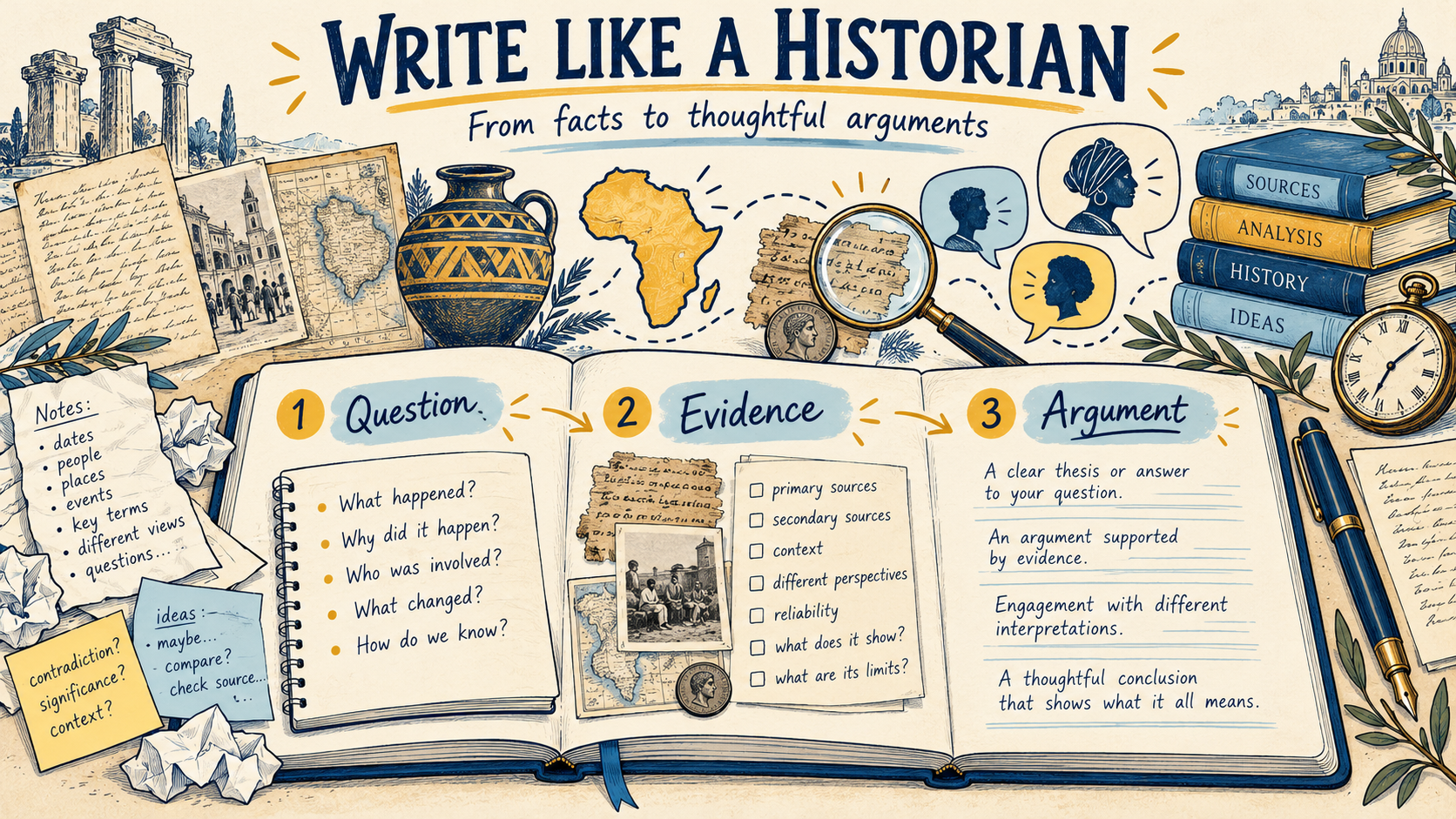
Knowing historical facts is important, but a history essay asks you to do more than remember them. You must select relevant evidence, explain what it means and use it to answer a particular question.
Many first-year students arrive at university accustomed to listing points. They may identify five causes of an event or name several consequences, yet leave the reader to work out how those points connect. At university, those connections are part of the answer.
Writing like a historian means making a reasoned argument about the past and supporting it with evidence. You do not need complicated language. You need a clear answer, accurate examples and an explanation of why those examples matter.
1. Know when point form is appropriate
Point form is useful when taking notes, planning an essay or answering a question that specifically asks you to list or identify. It is usually insufficient when a question asks you to explain, discuss, assess, examine or evaluate.
Consider this question:
Explain why African communities resisted colonial rule.
A student might write:
- Loss of land.
- Taxation.
- Forced labour.
- Loss of independence.
These are possible starting points, but they are not yet explanations. The answer does not identify particular communities, explain how colonial policies affected them or show why grievances produced resistance.
A developed paragraph might read:
Land alienation contributed to resistance where colonial authorities and settlers restricted African communities’ access to land. In central Kenya, the loss of land and insecurity surrounding African settlement became important grievances under colonial rule. Land supported cultivation and livestock keeping, but it also carried social and political significance. Restrictions on access therefore threatened livelihoods and challenged established claims to belonging and authority. These pressures helped generate opposition, although land grievances alone cannot explain the timing, leadership or different forms of resistance.
The paragraph identifies a cause, locates it in a historical setting and explains its significance. It also avoids suggesting that one cause explains every case.
Use points to plan your answer. Turn them into paragraphs when writing the essay.
2. Read the question before recalling your notes
A common mistake is to recognise a familiar topic and immediately reproduce everything remembered about it. A strong answer begins by establishing exactly what the question requires.
Identify four things:
| Part of the question | What to establish |
|---|---|
| Instruction | What must you do: describe, explain, compare or evaluate? |
| Subject | Which event, process, argument or experience are you discussing? |
| Scope | Which place, period or communities are included? |
| Required evidence | Does the question specify sources, examples or a particular number of cases? |
For example:
Using any two sources of African history, demonstrate why the claim that Africa had no history is misleading.
This question requires you to select two sources, show what historians can learn from them and explain how that evidence challenges the claim. An answer that merely lists archaeological sites or defines oral tradition would leave much of the task unfinished.
Understand the instruction words
| Instruction | What your answer should do |
|---|---|
| Identify / list | Name the relevant items accurately. Brief responses may be appropriate. |
| Describe | Present the main features or development of something. |
| Explain | Show how or why something happened. |
| Discuss | Examine the issue through a supported argument, considering relevant interpretations. |
| Compare | Explain similarities and differences using common criteria. |
| Assess/evaluate | Judge significance, effectiveness or validity using evidence and clear criteria. |
| To what extent | Establish how far a claim is convincing, while examining its limits. |
Follow any additional guidance provided by your lecturer. The wording of the particular question matters more than memorising a generic formula.
3. Develop an answer, not just a topic
An essay needs a central argument, sometimes called a thesis. This is your answer to the question, expressed in a sentence or two.
A topic statement announces what you will discuss:
This essay discusses oral tradition and archaeology.
An argument states what you will demonstrate:
Oral tradition and archaeology show that African societies had complex histories before colonial rule. Used critically, these sources reveal political organisation, economic activity and social change that cannot be understood by relying on written European records alone.
The second statement gives the essay direction. Each body paragraph should help establish, qualify or challenge part of that argument.
Your argument can acknowledge complexity. You do not have to choose between accepting a claim completely and rejecting every part of it.
4. Plan before you begin writing
A short plan helps you avoid repetition and irrelevant detail.
For the question about two sources of African history, a plan might include:
- An introduction explaining the problem and stating the argument.
- An explanation of what oral tradition can reveal.
- A specific example of oral evidence and a discussion of its limitations.
- An explanation of what archaeology can reveal.
- A specific archaeological example and a discussion of interpretation.
- A paragraph explaining how the sources can support or question one another.
- A conclusion answering the question directly.
This is a planning example, not a compulsory number of paragraphs. The depth of your answer should reflect the marks, time available and assignment instructions.
5. Write an introduction that answers the question
A useful introduction usually provides:
- Enough context to make the issue understandable.
- Clarification of any central term or claim.
- Your main argument.
- A brief indication of how you will develop it.
Avoid opening with statements so broad that they contribute little, such as “History began a long time ago” or “Africa is a very large continent.”
Example introduction
The absence of written records does not mean that a society lacks a history. It means that historians must consider other ways in which evidence of the past has survived. Oral tradition and archaeology provide important means of reconstructing African political, economic and social experiences. Although both require critical interpretation, they reveal changes and continuities that challenge the claim that Africa had no history. This essay demonstrates their value by examining remembered accounts of the past alongside material evidence.
This introduction takes a position and identifies the evidence that will support it. It does not attempt to explain the entire essay in advance.
6. Build paragraphs around claims, evidence and explanation
A paragraph should develop one main idea. A useful starting structure is:
Claim → Evidence → Analysis → Connection to the question
Claim
State the idea the paragraph will establish.
Archaeology challenges the assumption that Africa’s past can only be understood through written records.
Evidence
Provide a precise example.
At Great Zimbabwe, stone structures and recovered objects provide evidence of settlement, production and exchange.
Analysis
Explain what the evidence allows historians to argue.
Examining the construction, distribution and context of these remains helps historians investigate social organisation and connections beyond the settlement. Such material evidence makes it possible to study historical activity even where written accounts are limited.
Connection
Bring the paragraph back to the question.
The existence of this evidence therefore undermines the equation of limited written documentation with an absence of history.
These elements should flow together as prose. You do not normally label them “Claim,” “Evidence” and “Analysis” in the submitted essay.
The structure is a guide, not a rigid template. A substantial paragraph may need several pieces of evidence, a qualification or a comparison.
7. Explain your evidence instead of leaving it to speak for itself
An example does not automatically prove an argument. You must explain the relationship.
Compare these statements:
Evidence without explanation:
Imported objects have been recovered at African archaeological sites.
Evidence with analysis:
Imported objects can provide evidence of connections between African settlements and wider exchange networks. Their significance depends on their dating, location and archaeological context. They may demonstrate participation in trade, but they do not by themselves establish who controlled that trade or how its benefits were distributed.
The second version shows historical reasoning. It explains both what the evidence supports and what it cannot establish on its own.
After giving an example, ask yourself:
What does this show, and how does it help answer the question?
If you cannot answer, the example may need further explanation or may not belong in the essay.
8. Distinguish narration from analysis
Narration explains what happened. Analysis investigates how, why and with what significance.
| Mainly narrative | More analytical |
|---|---|
| Colonial governments introduced taxes. | Taxes increased pressure to obtain money and, in some settings, encouraged participation in wage labour. |
| Communities resisted colonial rule. | Communities resisted for different reasons, shaped by local experiences of land loss, labour demands and political interference. |
| Oral accounts were passed between generations. | Transmission preserved knowledge, but also created opportunities for accounts to be adapted to changing social and political circumstances. |
Narration has a place in a history essay. Readers need to understand events before assessing them. The problem arises when the entire answer becomes a sequence of events without explaining their significance.
9. Treat sources critically
Historians do not assume that a source is reliable simply because it is old, written or official. Nor do they reject a source merely because it expresses a particular viewpoint.
Ask:
- Who produced this source?
- When and where was it produced?
- Who was its intended audience?
- What purpose did it serve?
- What could its producer know?
- What does it emphasise, omit or take for granted?
- How does it compare with other evidence?
For example, a colonial report describing a community as “disorderly” provides evidence of how an official represented that community. It does not, by itself, establish that the description was accurate. It may also reveal official priorities, fears or attempts to justify intervention.
A source’s usefulness depends on the question you ask of it. A misleading account can still be valuable evidence of the attitudes or objectives of its producer.
10. Be precise about time, place and people
Avoid treating Africa, colonial authorities or African communities as if each were a single, unchanging group.
Instead of:
Africans resisted because Europeans took their land.
Write:
Land alienation was an important grievance in particular settler-colonial settings, but the causes and forms of resistance varied between communities and across time.
Precision also means distinguishing between historical periods. A practice documented in the twentieth century cannot automatically be assumed to have existed unchanged several centuries earlier.
Ask:
Which people? In which place? At what time? Under what circumstances?
These questions turn broad assertions into historical arguments.
11. Explain causes through connections
Naming a cause is not the same as explaining it.
Suppose you write:
Taxation caused resistance.
You still need to establish the connection. Did taxation place pressure on household resources? Was collection coercive? Did it challenge existing authority? Why did opposition develop in that place and period?
A developed explanation follows the process:
Colonial taxation could generate opposition when collection imposed burdens on households or involved coercive enforcement. Where people had limited access to cash, tax obligations could increase pressure to seek wage employment or sell produce. Resistance might therefore arise from the amount demanded, the methods of collection or objections to the authority imposing the tax.
Notice the careful language: could, where and might. These words acknowledge variation. They should accompany evidence, not replace it.
12. Consider different interpretations
Historical arguments often involve disagreement about causes, significance or the meaning of evidence.
You might argue that economic grievances were important while also showing that political authority, religion or local conflicts shaped how people responded.
A useful sentence could be:
Economic pressures help explain the growth of discontent, but they do not fully explain why resistance took different forms. Leadership, political organisation and local circumstances also influenced how grievances became collective action.
Considering an alternative interpretation strengthens your essay when you explain why your conclusion remains convincing. It should not become a list of unrelated opinions.
If you attribute an argument to a historian, represent it accurately and cite the work you have consulted.
13. Connect paragraphs logically
A good essay has a developing argument. Each paragraph should follow meaningfully from the previous one.
Useful transitions include:
- “This economic pressure also had political consequences.”
- “However, the evidence does not support the same conclusion in every region.”
- “Archaeology provides a different way of examining this problem.”
- “Read alongside oral accounts, these findings suggest…”
- “The importance of this factor changed over time.”
Avoid relying entirely on “firstly,” “secondly” and “thirdly.” These words indicate sequence, but they do not explain how ideas relate.
14. Use clear language and acknowledge your sources
Professional historical writing is precise rather than unnecessarily difficult.
Prefer:
Colonial taxation increased pressure on households to obtain cash.
Over:
The implementation of fiscal extraction mechanisms occasioned profound socioeconomic ramifications.
Use quotations sparingly and explain their significance. When you paraphrase someone else’s argument, acknowledge the source even though the wording is your own.
For coursework, follow the referencing system required by your lecturer. Use accurate page numbers for quotations where available. In examinations, follow the instructions on source attribution and references.
Never invent quotations, dates, sources or page numbers. If you are uncertain about a detail, verify it before including it in coursework.
15. End with a judgement
Your conclusion should return to the question and state what the evidence has established.
Avoid introducing a new case study or simply repeating your introduction word for word.
Example conclusion
Oral tradition and archaeology demonstrate why the absence of extensive written documentation cannot be equated with an absence of history. Oral accounts preserve and interpret experiences of political authority, migration and social relationships, while archaeological remains provide material evidence of settlement, production and exchange. Neither source gives unrestricted access to the past. Their value lies in critical interpretation and comparison. Together, they show that African history can be investigated through diverse forms of evidence.
The conclusion answers the question and recognises the limits of the evidence.
Common mistakes and how to improve them
| Common mistake | Better approach |
|---|---|
| Writing the whole answer in bullet points | Develop connected paragraphs unless the question requests a list. |
| Reproducing everything remembered about a topic | Select material that directly answers the question. |
| Making a claim without evidence | Add a specific, accurate historical example. |
| Giving evidence without explanation | Explain what it demonstrates and why it matters. |
| Treating an official document as automatically truthful | Examine its purpose, perspective and circumstances of production. |
| Generalising about all African societies | Specify the place, period and community. |
| Describing events without analysing them | Explain causes, relationships, changes and consequences. |
| Using complicated language to sound academic | Choose clear wording and precise concepts. |
| Introducing new arguments in the conclusion | Draw together the findings already established. |
A short practice exercise
Turn the following note into a developed paragraph:
Oral tradition is useful because it preserves African history.
Your paragraph should:
- Make a clear claim about what oral tradition can reveal.
- Use one specific example from your course readings or lectures.
- Explain how that example helps historians understand the past.
- Identify one limitation and explain how a historian might address it.
- Connect the discussion to the question being answered.
Do not invent an example. Return to your notes or readings and select evidence you can explain accurately.
Before submitting: check your answer
- Have I answered the exact question?
- Does my introduction state a clear argument?
- Does each paragraph develop a relevant idea?
- Have I supported my claims with specific evidence?
- Have I explained the significance of that evidence?
- Have I distinguished between different places and periods?
- Have I considered the limitations of my sources?
- Have I acknowledged the works I used?
- Does my conclusion give a supported judgement?
- Have I checked names, dates, grammar and references?
The most useful habit is to read each paragraph and ask: What am I arguing, what evidence supports it, and why does it matter to this question?
Keep exploring
Discover more articles on history, learning, careers and practical skills.
Browse all articles