The Querilla Journal
Imperialism in Latin America
Explore Spanish and Portuguese conquest, colonial society, resistance, independence and foreign influence in Latin America.
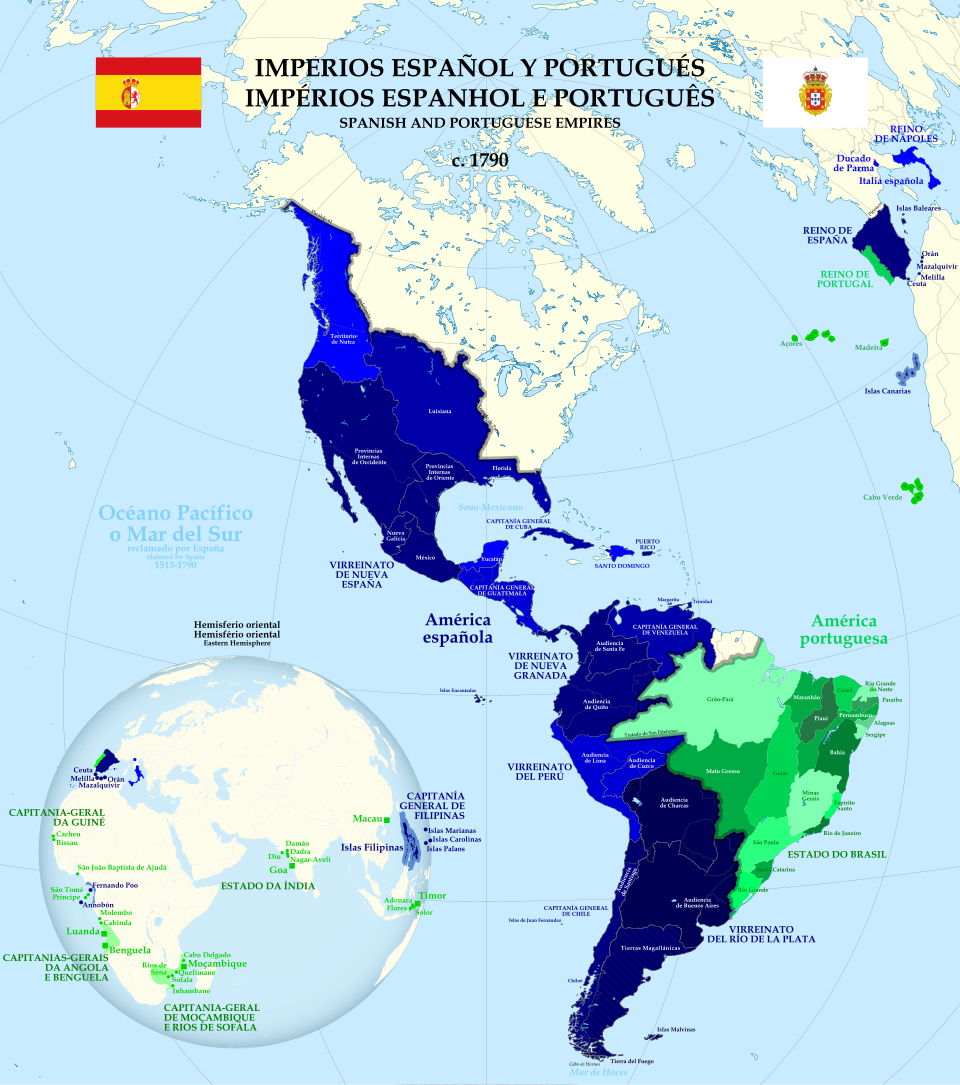
What does “Iberian” mean?
The Iberian Peninsula is in south-western Europe. It includes Spain and Portugal. So, Iberian conquest means the conquest of parts of the Americas by Spain and Portugal.
A colony is a territory ruled by another country. Spain and Portugal established colonies in Latin America from the late 1400s. Their rulers sent soldiers, settlers, priests and officials across the Atlantic to claim land, spread Christianity and gain wealth.
Learning focus
By the end of the lesson, students should be able to:
- Explain how Spain and Portugal conquered and governed parts of Latin America.
- Describe how colonial rule changed people’s lives, work, population and culture.
- Explain what changed during independence and what problems continued.
- Distinguish between direct colonial rule and later foreign influence.
1. How did Spain and Portugal conquer Latin America?
The Spanish and Portuguese did not conquer the whole region in one battle. They took control of different territories over time. Their success depended on military force, Indigenous alliances, disease and political organisation.
Example: The Spanish conquest of Mexico
In 1519, the Spanish soldier Hernán Cortés arrived in Mexico. His forces were small compared with the population of the region. He gained support from Indigenous groups who opposed the powerful Mexica, often called the Aztecs. With those allies, Spanish forces attacked the Mexica capital, Tenochtitlan. The city fell in 1521. The Library of Congress describes both the Spanish attack and the role of Tenochtitlan as the capital of the Mexica Empire.
This example helps us see that the Spanish did not win through their own weapons alone. Indigenous allies played an important part in the conquest.
Example: The Spanish conquest of the Inca Empire
In 1532, Francisco Pizarro and a small Spanish force captured the Inca ruler Atahualpa at Cajamarca in present-day Peru. The Inca Empire was already weakened by a struggle for power between Atahualpa and his brother Huáscar. Spanish attacks, political divisions and disease all contributed to the fall of Inca rule.
Factors that helped the conquest
- Indigenous alliances: Some communities supported the Spanish against their rivals. These alliances gave the Spanish more fighters and local knowledge.
- Weapons and horses: Steel swords, guns and horses gave Spanish soldiers advantages in some battles.
- Disease: Europeans brought diseases such as smallpox. Indigenous people had not encountered some of these diseases before, and many died.
- Political divisions: Some Indigenous states were divided by conflict or succession struggles.
- Religion and government: Spanish and Portuguese rulers sent missionaries and officials to support colonial rule.
Disease was a major cause of Indigenous population loss, but it was not the only cause. Warfare, forced labour, hunger and displacement also caused deaths. The effects differed across the region.
2. How did Spain and Portugal govern their colonies?
Spain and Portugal created governments to control land, collect taxes, regulate trade and direct labour.
- The Spanish Crown ruled colonies in the name of the Spanish monarch. Large territories were organised into viceroyalties, each governed by a viceroy, the king’s representative.
- Courts and town councils helped administer the colonies. Spanish officials used institutions such as the audiencia, a high court, and the cabildo, a local town council.
- Portuguese Brazil was also governed for the Portuguese Crown. Officials supervised settlement and trade, while landowners developed plantations and later mining.
These institutions helped the European crowns govern large territories from across the Atlantic. They also helped channel wealth and resources to Spain and Portugal.
3. How did colonial people work?
Colonial economies needed labour for mining, farming and other work. Indigenous people and Africans were forced to do much of this labour, though the systems were different.
Encomienda
The encomienda was a Spanish system that allowed a colonist to collect tribute or labour from an Indigenous community. In theory, the colonist was meant to protect the people and teach them Christianity. In practice, colonists often demanded harsh and excessive labour.
Silver mining and the mita
The Spanish mined silver in places such as Potosí, in present-day Bolivia. Silver mining began there in 1545 and became a major source of wealth for Spain. Spanish officials adapted the Indigenous mita system into a forced labour draft. Under this system, Indigenous communities had to send people to work in the mines. The Library of Congress records how colonial officials used the mita to supply labour to Potosí.
Simple example: The silver came from the Americas, but much of the wealth went to the Spanish Crown and merchants. Indigenous workers paid a heavy human cost.
Plantations and slavery in Brazil
Portuguese landowners established sugar plantations, especially in coastal areas such as Bahia and Pernambuco. They forced enslaved Africans to work in the fields, mills and households.
Millions of Africans were forcibly taken across the Atlantic. They did not choose to migrate. They were captured or sold, transported in terrible conditions and forced to work without freedom.
Encomienda, the mita and African slavery were not the same system. They all involved exploitation, but they had different rules and affected people in different ways.
4. How did people resist colonial rule?
People did not simply accept colonial control. They resisted in many ways: through rebellion, escape, legal action, community organisation and preserving their culture.
Examples of resistance
- Quilombo dos Palmares, Brazil: Enslaved Africans who escaped established communities known as quilombos. Palmares was one of the largest and most famous. It resisted Portuguese attempts to destroy it for much of the seventeenth century.
- Túpac Amaru II’s rebellion, Peru: In 1780, Indigenous leader Túpac Amaru II led a major rebellion against Spanish colonial authorities and abuses in the Andes.
- Everyday resistance: People could run away, slow their work, keep local religious practices or use colonial courts to challenge unfair treatment.
Resistance took different forms. Some people fought openly, while others protected their families and communities through less visible actions.
5. How did colonial rule change society and culture?
Population
Many Indigenous communities experienced a severe decline in population after European arrival. Disease was one cause. War, forced labour, hunger and people being moved from their homes added to the losses.
The forced arrival of Africans also changed the population of Latin America. The region became home to Indigenous peoples, people of African descent, Europeans and communities of mixed ancestry.
Language and religion
Spanish and Portuguese became widely spoken. Catholicism became the major organised religion. But Indigenous and African beliefs and practices continued.
In Cusco, in present-day Peru, the Spanish built the Church of Santo Domingo on the site of the Inca temple of Qorikancha. The location shows how colonial rule changed the city’s religious landscape. At the same time, Indigenous traditions continued in the region.
Culture and identity
People adapted, combined and protected different cultural traditions. Some communities blended Catholic beliefs with Indigenous or African practices. This blending is often called syncretism.
Colonial governments and societies also placed people into racial and social categories. A person’s ancestry could affect their status and opportunities. These categories were not identical everywhere, and people sometimes challenged them through courts, rebellion and community action.
6. Independence: what changed and what continued?
Most Latin American countries became independent from Spain and Portugal during the late eighteenth and early nineteenth centuries. Independence ended direct European rule in many places, but it did not immediately bring equality or freedom to everyone.
Examples of independence movements
- Haiti: Enslaved people began a revolution in 1791. Haiti became independent in 1804. Its independence showed that enslaved people could defeat a colonial power and establish their own country.
- Spanish America: Independence struggles spread across the region from 1810. Leaders included Simón Bolívar in northern South America and José de San Martín in the south.
- Brazil: Brazil declared independence from Portugal in 1822, with Dom Pedro I becoming its ruler.
Indigenous, African and mixed-race people took part in many independence struggles. They often hoped for freedom, land and better treatment. Their aims did not always match those of wealthy local leaders.
What did independence fail to change?
Independence did not automatically end:
- slavery;
- large landholdings by wealthy families;
- poverty among Indigenous and African-descended communities;
- racial discrimination;
- unequal access to political power.
Brazil, for example, did not abolish slavery until 1888. Across Latin America, the dates and conditions of abolition differed.
Key point: Independence changed who governed, but many social and economic inequalities continued.
7. Foreign influence after independence
After independence, Latin American countries had their own governments. However, powerful countries and foreign companies could still influence their economies and political decisions. This is often called informal imperialism.
It could happen through:
- trade and loans;
- foreign investment;
- control of railways, ports or mines;
- diplomatic pressure;
- military intervention.
Example: Britain and trade
During the nineteenth century, Britain became an important trading and financial partner for Latin American countries. British businesses and banks invested in areas such as trade, transport and public infrastructure. This influence did not usually mean that Britain formally governed the countries.
Example: The United Fruit Company in Guatemala
The United Fruit Company, a US company, owned large areas of land and had major business interests in Guatemala. In 1952, Guatemalan president Jacobo Árbenz introduced land reform. In 1953, the government ordered the transfer of about 234,000 acres of United Fruit Company land, offering government bonds as compensation. The company and its property became part of a wider conflict over land, business interests and US influence.
In 1954, Árbenz was overthrown after a US-backed operation. This case helps us discuss how foreign business interests and government policy could become connected. Historians examine the different political and economic factors involved, so it is better not to explain the entire event through the company alone.
Direct colonial rule and informal imperialism
Review questions
Short class activityAsk students to discuss this question in pairs: If a country has its own government but foreign companies own much of its land or control important businesses, is the country fully independent? Give one reason for your answer. | |||||||||
|---|---|---|---|---|---|---|---|---|---|
|
Keep exploring
Discover more articles on history, learning, careers and practical skills.
Browse all articles