The Querilla Journal
What to Put on Your CV When You Have No Work Experience
No work experience? Learn how to turn university projects, volunteering and student leadership into useful CV content, with practical examples.
What to Put on Your CV When You Have No Work Experience
You have found an opportunity that interests you. Then you open a blank document and face the question: What can I put on my CV if I have never had a formal job?
For many students and recent graduates, the problem is not a complete absence of experience. It is knowing how to recognise relevant experience and describe it clearly.
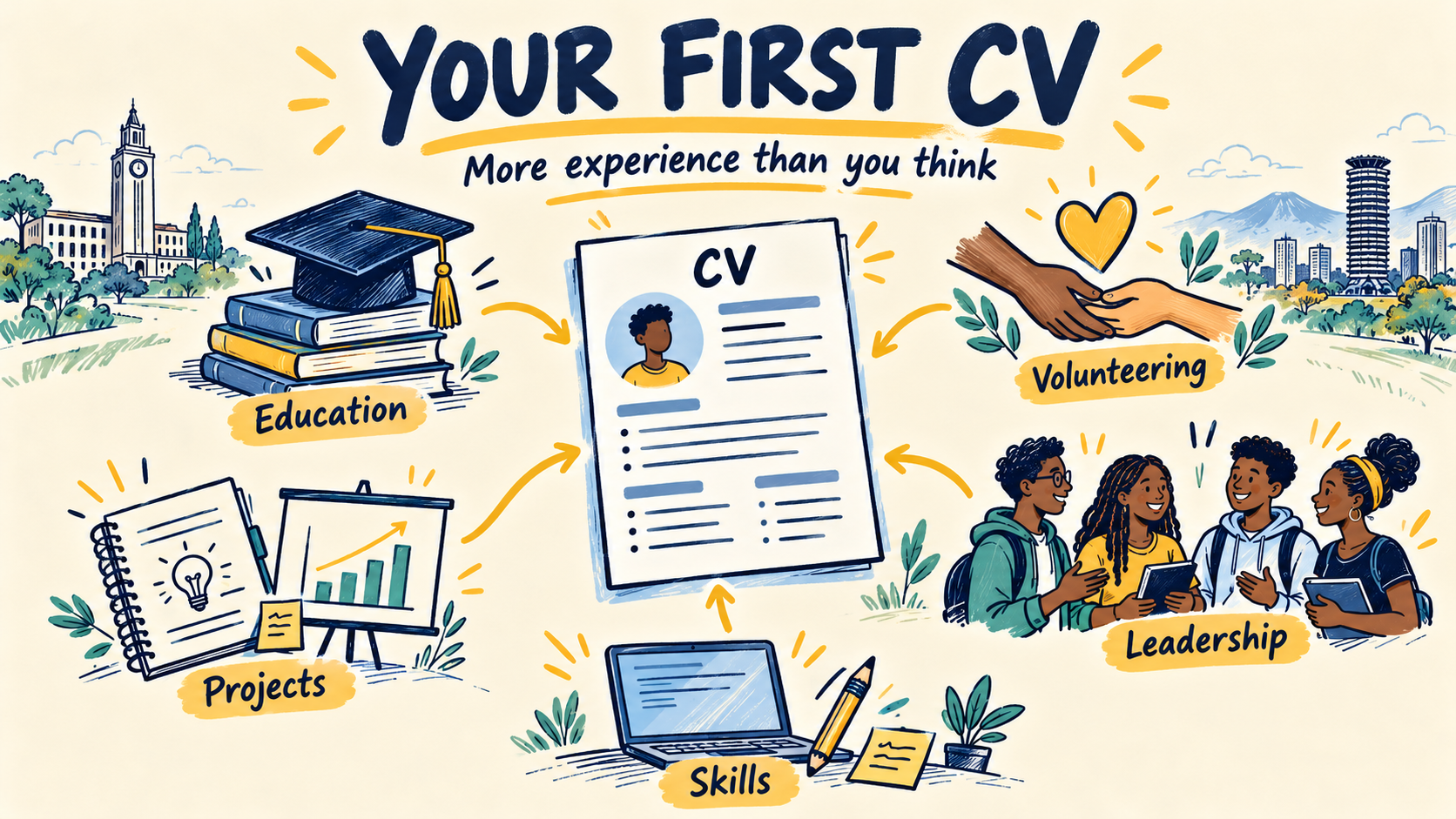
University projects, volunteering, student leadership, industrial attachment and responsibilities in a family business can provide useful evidence of your abilities. They do not need to be presented as paid employment to have value.
The aim is to show what you have actually done, what you learned and how that relates to the opportunity.
Start with the opportunity, not a downloaded template
Before writing your CV, read the job or attachment advertisement carefully.
Identify the tasks involved and the abilities requested. Then look for truthful examples from your studies and other activities.
For an entry-level administrative role, your notes might look like this:
| Requirement in the advertisement | Possible evidence from your experience |
|---|---|
| Keeping accurate records | Maintaining a student association attendance register |
| Written communication | Preparing project reports or meeting minutes |
| Teamwork | Completing a group assignment with shared responsibilities |
| Research | Finding, evaluating and organising sources for a university project |
| Customer communication | Answering enquiries while helping in a family business |
Include an example only if it reflects something you actually did. The table is a starting point for identifying evidence, not a list of claims to copy.
What sections should your first CV contain?
A useful starting structure is:
- Name and contact details.
- A short professional profile.
- Education.
- Relevant projects and experience.
- Skills.
- Additional relevant activities or training.
Adjust the order to your strongest evidence. If your attachment closely matches the vacancy, you may place it before your education.
Oxford University’s careers guidance similarly recognises that applicants without direct work experience can demonstrate transferable skills through their studies and responsibilities. Oxford University
Name and contact details
Include your name, a working telephone number and a professional email address. You can add your town or city and a relevant LinkedIn profile or portfolio.
Check that the details are correct and that any linked profile is ready for an employer to view.
Follow the application instructions about additional information. Avoid including sensitive personal details that are unnecessary for the application.
A short professional profile
Your profile should introduce your current position, relevant strengths and target opportunity.
Avoid statements that could belong to almost anyone:
I am a hardworking, self-motivated individual seeking a challenging position in a reputable organisation.
A more useful profile is specific:
History undergraduate seeking an administrative attachment. Experienced in organising research materials, preparing group reports and coordinating student activities. Comfortable using Microsoft Word and spreadsheets for document preparation and basic record keeping.
This is an illustrative example. Change the subject, skills and activities to match your own background.
You do not need to describe yourself as an expert. Give the reader a clear, credible starting point.
Turn coursework into evidence of ability
A project becomes useful CV content when you explain your contribution.
Simply writing “Completed university assignments” tells an employer very little.
Instead, identify:
- The subject or purpose of the project.
- Your responsibilities.
- The methods or tools you used.
- The output you helped produce.
Example: a history research assignment
Before:
Did a group project on African history.
After:
Located and compared published sources for a group project on African history, organised research notes and contributed to the final report and presentation.
The revised version shows research, organisation and communication. It does not invent a job title or exaggerate the assignment.
If you carried out interviews, transcribed recordings or organised archival references, those activities may also be relevant. Describe them accurately and avoid disclosing confidential research information.
Include volunteering and community responsibilities
Unpaid work can involve real responsibilities.
You may have supported a community organisation, helped organise an event, tutored younger students or assisted with a local initiative.
Give the activity a clear label so the reader understands its nature.
Illustrative example:
Community Event Volunteer
[Organisation], [Month Year]
- Helped register participants and direct them to event activities.
- Prepared attendance records and checked entries for completeness.
- Worked with other volunteers to answer routine participant questions.
These statements explain what the person did. “Passionate volunteer with excellent leadership skills” would be less informative without supporting examples.
Describe student leadership through responsibilities
A title alone does not show the extent of your contribution.
Instead of:
Class representative.
Write:
Communicated timetable updates between lecturers and classmates, gathered student questions and helped coordinate information about group presentations.
For a club or society role, consider whether you:
- Organised meetings.
- Prepared minutes.
- Maintained records.
- Coordinated volunteers.
- Communicated with members.
- Helped prepare a budget or track expenditure.
Only include responsibilities you genuinely held. Being a member of a committee does not automatically mean that you managed its finances or led its activities.
Family-business experience can be relevant
Helping in a family business may involve customer service, record keeping, stock handling or delivery coordination.
Describe the arrangement honestly.
Illustrative example:
Part-time Support, Family Retail Business
[Town], [Dates]
- Responded to customer enquiries and assisted with routine purchases.
- Recorded daily sales in a spreadsheet.
- Helped check stock levels and identify items requiring replenishment.
Do not upgrade occasional assistance into a management position. A modest, accurate description is easier to explain confidently in an interview.
Write skills that you can demonstrate
A long list of qualities does not necessarily strengthen your CV.
If you write “communication,” “leadership” and “teamwork,” the reader still needs to know what supports those claims.
Connect each skill to an activity:
| General claim | More informative description |
|---|---|
| Research skills | Located and compared sources for an undergraduate research project |
| Microsoft Excel | Used spreadsheets to organise attendance records and calculate totals |
| Communication | Presented group findings and responded to classmates’ questions |
| Organisation | Coordinated meeting schedules and circulated agreed action points |
Be precise about software knowledge. If you can enter data and use basic formulas, say that rather than claiming advanced proficiency.
Use numbers when they are accurate
Numbers can make experience easier to understand, but they are not compulsory in every bullet.
For example:
Coordinated presentation tasks for a group of six students.
This is more specific than “Worked in a large team,” provided the number is accurate.
However, do not invent percentages or claim results you cannot substantiate.
A statement such as:
Organised project notes and checked references before submission.
can be useful without adding an unsupported claim that you “improved efficiency by 80%.”
Keep the layout easy to read
Choose a simple layout with clear headings, consistent spacing and readable text.
For a student with limited relevant experience, one well-organised page can be enough. Use additional space when it contains useful information rather than repetition.
Before submitting:
- Follow the employer’s requested file format.
- Check that dates and headings are consistent.
- Remove empty sections and template instructions.
- Make sure the text remains readable when exported.
- Use a clear filename, such as
Your_Name_CV.pdf.
You can explore our CV samples for ideas about presenting information. Use examples to understand structure, not to copy someone else’s experience.
Mistakes to avoid on a CV with no work experience
Apologising for being a beginner
You do not need to open with “Unfortunately, I have no experience.” Present your current stage and the relevant evidence you do have.
Inventing employment
Do not create an employer, job title or responsibility to fill space. Label projects, volunteering and informal work accurately.
Sending the same content everywhere
Your background stays the same, but the most relevant parts may change between applications. Adjust the emphasis to the actual role.
Listing every course or activity
Select material that helps explain your suitability. More information is not automatically more convincing.
Claiming skills you cannot explain
If an interviewer asks for an example, you should be able to describe what you did and how you did it.
Frequently asked questions
Can I write a CV before graduating?
Yes. State your qualification as ongoing and include your expected completion date if known. Distinguish clearly between completed qualifications and those still in progress.
Can I include industrial attachment?
Yes. Identify the organisation, dates and tasks you carried out. Explain your own contribution rather than copying the department’s general functions.
Should I include secondary-school information?
Include it when the employer requests it or when it is relevant to your current stage. As your qualifications and experience develop, review how much space it needs.
Can I use AI to help write my CV?
You can use it to organise notes or improve wording. Check every statement carefully. Remove invented achievements, inflated job titles and skills that do not reflect your abilities.
What if I have very little to include?
Start with your education and one or two relevant activities. A short, truthful CV is more useful than a longer document filled with vague claims. You can also build experience through suitable projects, volunteering and opportunities offered through your institution.
Need help presenting your experience?
You do not need a long employment history to begin writing a useful CV. You need to identify relevant activities, explain your contribution and connect it to the opportunity.
If you would like personal support, explore Querilla Marketing’s CV-writing packages. Share your target role and current draft so we can agree the scope, fee and delivery arrangements before work begins.
When publishing: add a link to this article from your student resources page and your earlier first-job guide. Use a descriptive link such as “what to include in a CV without work experience.” Add an accurate author name and review the examples before publication.
Keep exploring
Discover more articles on history, learning, careers and practical skills.
Browse all articles